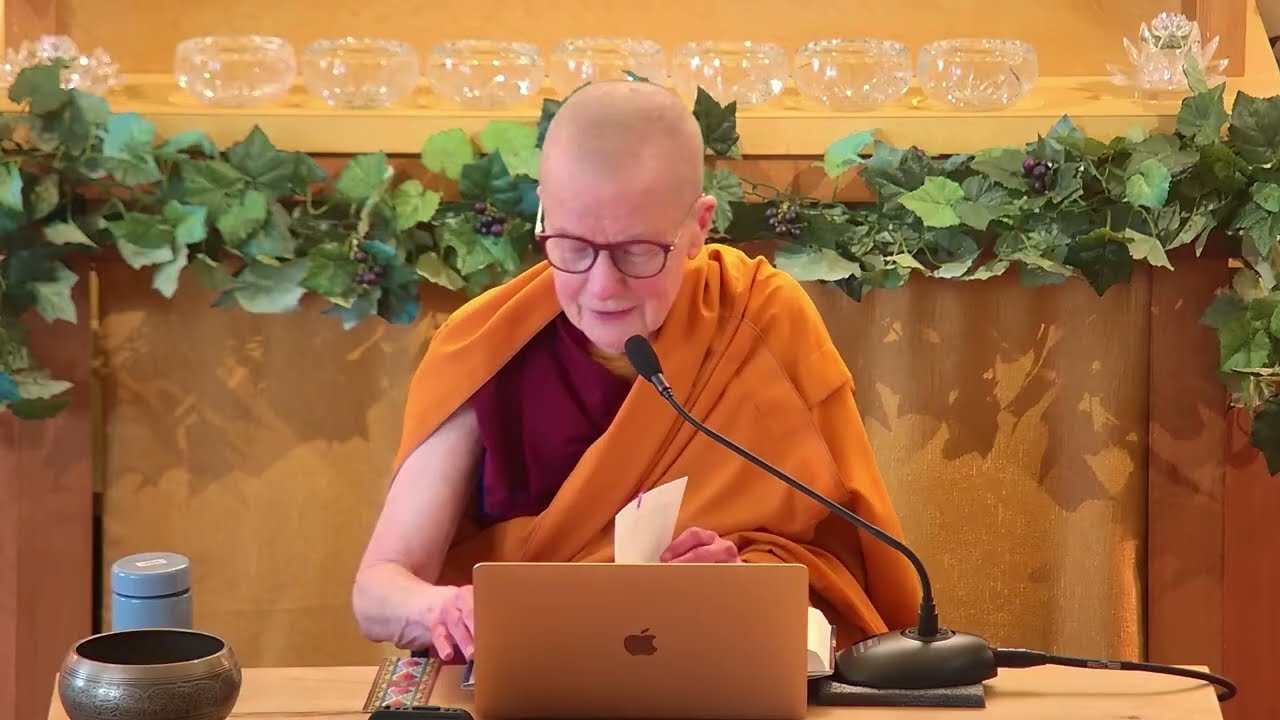
Introspective awareness
89 Following in the Buddha's Footsteps
 Venerable Thubten Chodron
  Volume 4 Following in the Buddha's Footsteps
  Mar 20, 2026
 Part of an ongoing series of teachings based on the book Following in the Buddha's Footsteps, the fourth volume in The Library of Wisdom and Compassion series by His Holiness the Dalai Lama and Venerable Thubten Chodron.
- How Aryas use mindfulness
- Keeping mindfulness on a virtuous topic in the break times
- Restraining the senses to restrain the mind
- Mindfulness vs bear attention
- Mindfulness in cultivating ethical conduct, serenity and wisdom
- Different definitions of introspective awareness
- What to practice and what to abandon
- Various ways of describing how introspective awarenesss functions
- Accompanies correct views, supports development of reliable analytical wisdom and supports the practice of serenity
- Purpose, suitability, domain and non-ignorance
- General context and specific context
- Abiding in awareness
89 Introspective Awareness (download)
Contemplation points
- How do we employ mindfulness when contemplating a particular Dharma topic?
- What are ways we can employ mindfulness when we’re in between meditation sessions, going about our day?
- Notice your own mind and how, when your senses are unguarded, you become involved with sensory objects. From your own experience, how does this bring about afflictions? How does mindfulness help us from getting lost in the proliferation of thoughts, opinions, preferences, and emotions?
- What is the role of mindfulness in cultivating ethical conduct?
- What is the role of mindfulness when cultivating serenity?
- How does mindfulness differ from bare attention?
- What is introspective awareness and how does it operate in our mind? Make examples from your own life and the world around you using the three types: 1) accompanies correct views, 2) understands the object and supports the development of reliable analytical wisdom, and 3) enables the mind to attend to the meditation object and supports the practice of serenity.
- What is non-introspective awareness and how does it contribute to the increase of destructive actions of body, speech, and mind? Use examples from your own life and from the world around you using the three types: 1) that accompanies wrong views, 2) that hinders development of reliable analytical wisdom because it misunderstands the object, and 3) that interrupts serenity because the mind is unable to attend alertly to the meditation object.
- Imagine living in each moment with an awareness of the four types of introspective awareness as described in the Pali commentaries: 1) introspective awareness of purpose, 2) introspective awareness of suitability, 3) introspective awareness of the domain, and introspective awareness of nonignornace. How might this change the way you view and interact with the world around you?
- What does it mean to “abide in awareness?” What are some ways you can incorporate this more into your daily life?

Venerable Thubten Chodron
Venerable Chodron emphasizes the practical application of Buddha’s teachings in our daily lives and is especially skilled at explaining them in ways easily understood and practiced by Westerners. She is well known for her warm, humorous, and lucid teachings. She was ordained as a Buddhist nun in 1977 by Kyabje Ling Rinpoche in Dharamsala, India, and in 1986 she received bhikshuni (full) ordination in Taiwan. Read her full bio.